


- By DigitalMarketingClub
- No Comments
- Blog
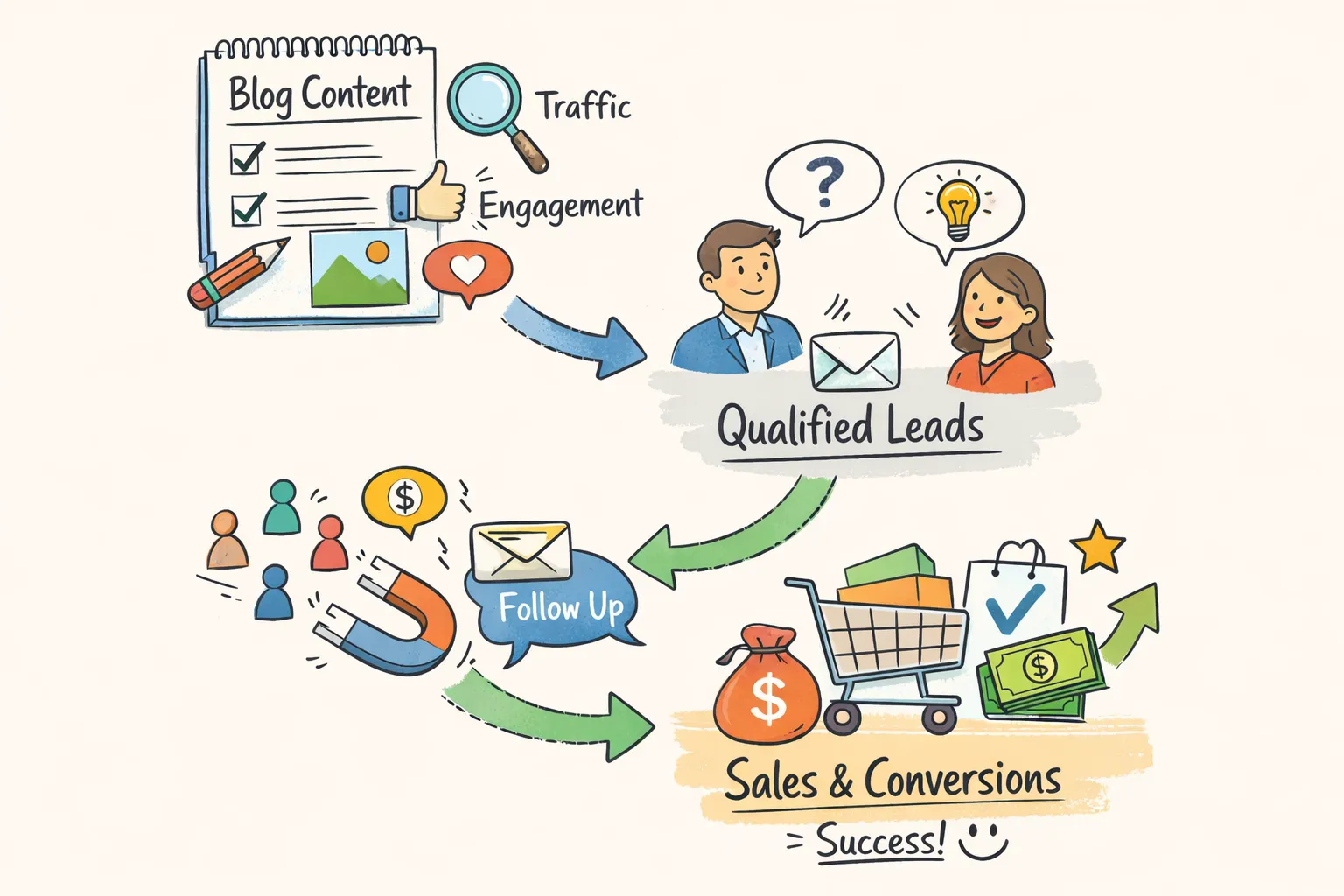
Most blogs siphon traffic but few reliably create sales-ready contacts. That gap isn’t a content problem — it’s a funnel problem. If you design every post to push a measurable micro-conversion, you stop chasing vanity metrics and start producing reliable inbound lead flow.
By the end of this article you’ll be able to pick the content formats that actually convert, design lead magnets and CTAs that earn emails, wire an automation nurture that qualifies leads, and measure what matters with realistic benchmarks and A/B ideas. This is the exact funnel we run in Digital Marketing Club’s live labs — and members turn posts into predictable MQLs.
Map the content-to-lead funnel: choose your north star and KPIs
Start by mapping content to buyer stages: Awareness → Consideration → Decision. Awareness drives discovery and audience qualification; Consideration educates and proves fit; Decision pushes to a purchase action or meeting.
Pick a single primary conversion for each stage (examples: newsletter signup, checklist download, webinar registration, demo request). Then set three north-star metrics that link content to outcomes: session→lead percentage, lead→MQL conversion, and cost per lead when you amplify with paid channels. These are the numbers your team can optimize directly.
Use sensible benchmarks to set expectations: content-driven session→lead rate for B2B commonly sits between 0.3%–2% (typical 0.8%–1.1% in many programs); top-performing intent pages hit 3%+. Webinars perform well in B2B (registrants→leads and attendees→MQLs often outperform passive assets). Keep your targets iterative: improve one metric at a time.
One-line funnel mapping (deliverable): Top: blog SEO → Checklist download → Mid: webinar → Demo request → Bottom: trial/demo.
Pick the right content: 11 high-converting formats (grouped by funnel stage)
Awareness — scale and qualify
SEO-optimized blog posts: Use intent-driven topics and built-in CTAs (inline checklist or email capture). Expect low session→lead but high scale; CTA: “Get the quick checklist.”
Short-form video (social): Great for low-friction reach and rapid audience qualification—use link-in-bio CTAs to content with a capture point. CTA: “Watch 60s tip → get full guide via email.”
List posts & thought pieces: Drive curiosity and topical authority; add a soft CTA to build your newsletter or content upgrade. CTA: “Subscribe for the 5-step template.”
Consideration — educate and qualify
Webinars & live workshops: B2B webinars commonly convert around 2.3% to registration-based lead actions and produce warm MQLs when followed up quickly. CTA: “Register — limited seats.” For practical webinar lead generation tactics and formats, see Remo’s webinar lead generation guide.
Interactive tools, quizzes & calculators: These often double conversions vs passive assets by delivering personalized results. CTA: “Calculate your savings → get results by email.”
Case studies: Use narratives to prove outcomes for similar ICPs; gate a bundle or ask for email to download. CTA: “Download the case bundle.”
Comparison guides: Help buyers narrow options; include gated checklists and demo options on high-intent pages. CTA: “Compare plans + get our buyer checklist.”
Long-form guides / eBooks: Deep education assets for mid-funnel engagement—great for progressive profiling. CTA: “Download the guide.”
Decision — convert and close
Demos and ROI calculators: Use these on high-intent pages; ROI calculators often persuade finance stakeholders. CTA: “See your ROI → book a demo.”
Gated buyer checklists: Short, tactical checklists convert well as final nudges for demo/consult chats. CTA: “Get the buyer checklist.”
Free trials / consultations: Use frictionless signups with a low-barrier calendar booking. CTA: “Book a free consult.”
Repurpose one asset into many touchpoints: clip webinars into short videos, transform guides into checklists and an email course, convert calculator results into tailored follow-up sequences—this stretches production and increases touch frequency.
Lead magnets & gating that actually convert (how much to ask, when to gate)
Match value to ask: a one-page template deserves an email; a personalized assessment or ROI calculation justifies a short form or calendar booking. When in doubt, start with progressive profiling: ask email only first, then collect role and company over subsequent touchpoints.
Gating strategies: ungated asset plus CTA (low friction, high reach), fully gated asset (higher conversion rate, smaller audience), progressive gating (best for B2B nurture where qualification matters). B2C favors shallower asks and discounts; B2B benefits from progressive profiling and interactive assessments.
High-converting magnet types include templates/checklists (consistently strong CR), interactive quizzes/calculators (high engagement and personalization), webinars (warm leads), and case study bundles (B2B credibility). Use direct CTA copy: “Get the one-page competitor brief” and form label copy such as “Email to receive the template — no spam.” Keep first forms to 1–3 fields, add a short social-proof line under CTAs, and reassure privacy. Deliver the asset immediately and use the thank-you page to surface next actions. For inspiration on effective lead magnets and examples, see lead magnet ideas and examples.
Capture, score, and nurture: an automation playbook
Capturing an email is only half the job—the qualification and nurture sequence turn signups into sales-ready conversations.
Place capture points where intent aligns: inline CTAs on high-value posts, exit-intent for discovery pages, slide-ins after scroll thresholds, and chat widgets for instantaneous booking. Add micro-conversions (video watch → CTA click) to your scoring model and use one-click booking (Calendly) for demo-ready prospects.
Nurture sequence blueprint (example):
Immediate: Deliver the magnet + one quick tip (send within 5 minutes). Subject hook: “Your [magnet] + 1 quick idea.”
Day 2: Case study showing an outcome for a similar ICP. Subject hook: “How X gained Y in 60 days.”
Day 6: Product-use case or tutorial + invite to a live workshop or demo. Subject hook: “See it in action — limited spots.”
Day 10: Final CTA: book a meeting or start a trial; include social proof and low-friction next step. Subject hook: “Ready to test it? 15-minute demo.”
Lead scoring and segmentation should combine engagement points and firmographic fit. Example scoring: email open = 1pt, click = 3pts, webinar attendance = 10pts, pricing page view = 15pts, demo request = 50pts; role/company fit = 10–20pts. Flag MQLs when engagement + fit exceeds your threshold (e.g., 50–75 pts) and route automatically to sales with a one-click meeting link. For high-value B2B, layer LinkedIn outreach and retargeting ads as part of the follow-up cadence.
Set SLAs for handoffs (e.g., sales outreach within 24 hours for demo requests), capture talk tracks for the highest-converting assets, and build a reactivation playbook for dormant leads.
Measure, test and scale: KPIs, benchmarks and A/B ideas
Measurement is a funnel. Track sessions and the organic keywords bringing intent traffic, session→lead %, lead→MQL %, email opens/clicks, demo-to-deal conversion, and CPL when paid is involved. Use benchmarks to prioritize: B2B content session→lead often ranges 0.3%–2% (typical 0.8%–1.1%); webinars are strong in B2B (registrant/attendee flows and MQL yield), and interactive assets commonly double passive conversions. For industry conversion rate benchmarks, consult conversion rate benchmarks.
Run a small set of prioritized experiments to improve one conversion at a time. Focus first on the thing that will move your north-star metric. For conversion optimization statistics and test ideas, see conversion rate optimization statistics.
- Headline & hero CTA test on a high-traffic post
- Lead magnet formatA/B(template vs interactive quiz)
- Gating vs ungated on an intent page
- Form length reduction (3 fields → 1 field)
- Personalized CTA by traffic source
Report weekly with four simple numbers for leadership: new leads, MQLs, CPL (if amplifying), and your top-performing asset. Use monthly trend commentary to explain what changed and your next experiment.
When scaling with paid, amplify your top 1–2 highest-converting assets first and measure incremental CPL versus baseline organic return.
30-day launch blueprint + templates & support from Digital Marketing Club
Ship a testable funnel in 30 days. The goal is one published asset, one lead magnet, a capture page, and a 3-email nurture sequence wired to your CRM and basic scoring.
Week 1
Define your ICP, pick 1–2 topics aligned to buyer intent, map the funnel end-to-end, and choose a single lead magnet and CTA.
Week 2
Create the asset: webinar slides, template, or calculator. Build a focused landing page and write hero copy aligned to your chosen CTA.
Week 3
Wire capture: form, thank-you page, and a 3-email nurture. Configure basic tracking (UTMs, conversions) and implement lead scoring rules.
Week 4
Soft launch to your list and organic channels, run initial A/B tests, review early data, and share the asset in Digital Marketing Club’s live workshop or community for feedback from practicing marketers.
Deliverables you should have by day 30: landing page wireframe, headline + CTA swipe file, 3-email nurture templates, a simple lead-scoring example, and a measurement dashboard. These templates and peer feedback sessions are available inside Digital Marketing Club’s live labs and community resources to accelerate iteration.
Map, create, capture, nurture, measure — repeat. Small, measurable wins in 30 days compound into predictable pipeline when paired with continual testing and community feedback. If you want instant accountability and swipeable templates, bring this plan to a Digital Marketing Club live lab and get hands-on critique from marketers who do this every week.