


- By DigitalMarketingClub
- No Comments
- Blog
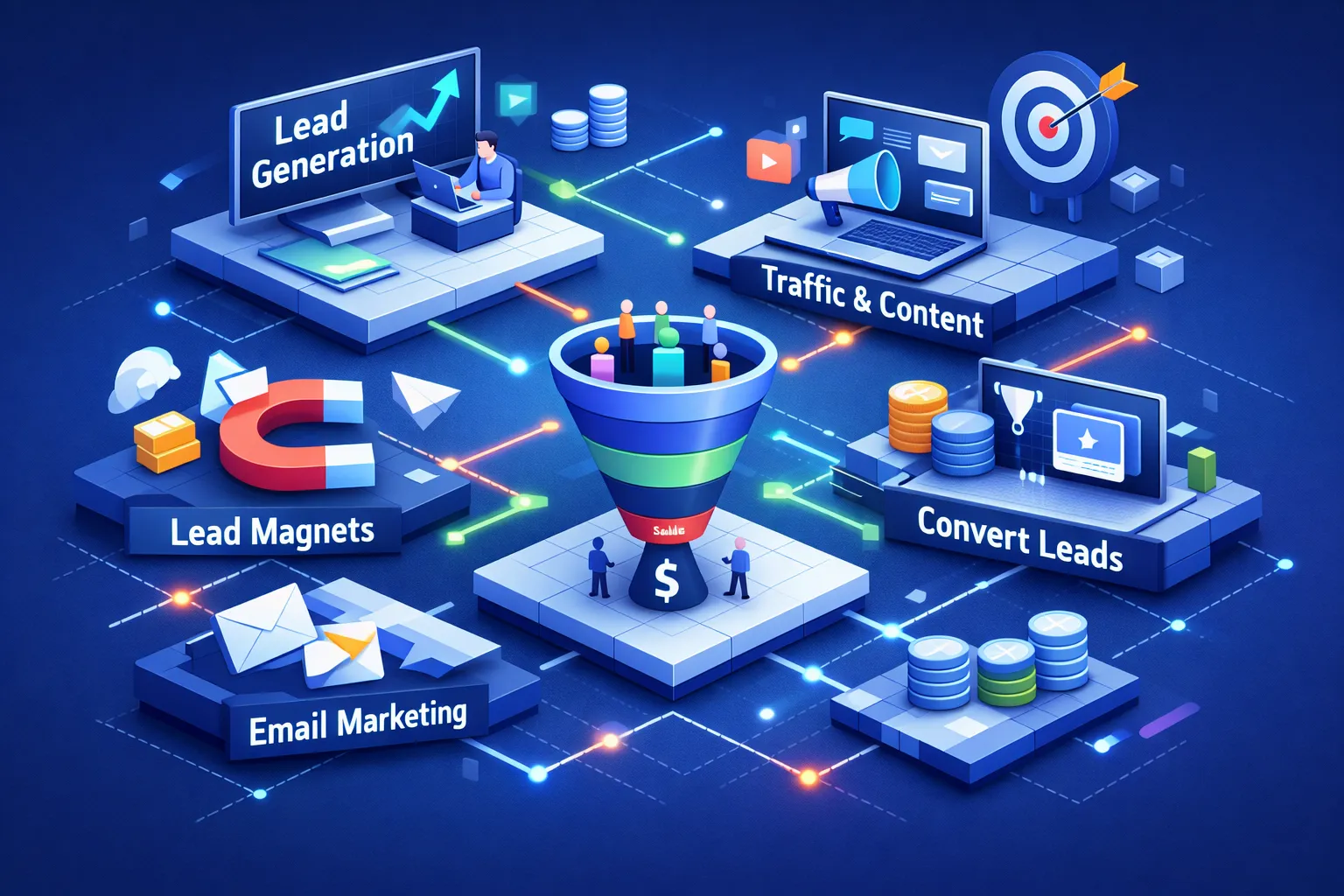
You’ll finish with a prioritized, actionable content-to-lead plan: choose 3–5 tactics, map each to the buyer journey, build a high-converting lead magnet and landing page, set KPIs, and follow a 30/90‑day execution checklist. This isn’t theory — it’s the exact playbook we run in Digital Marketing Club workshops: templates, scripts and repeatable steps so you can test fast and scale winners.
1) Choose 3–5 tactics: the 12 proven plays
Focused execution beats spreading thin. Pick a small set of plays you can produce well and optimize weekly. Below are twelve reliable content-led lead gen plays with the funnel fit and why they convert.
| Tactic | Funnel fit | Why it converts / Repurpose potential |
|---|---|---|
| Gated downloads (ebooks/whitepapers) | MOFU / BOFU | High lead intent; great for email nurture; chapters become blog posts and social excerpts |
| Webinars & live demos | MOFU | Strong registration-to-lead performance; record to repurpose as on‑demand video clips |
| Video (short + long form) | TOFU → BOFU | Landing-page lifts (~+86%); short-form for reach, demos/testimonials for conversion |
| Case studies (gated or landing) | BOFU | High-quality intent leads; ideal for sales conversations and proposal materials |
| Blog pillar content (SEO) | TOFU | Scales organic traffic; feeds long-term top-of-funnel volume and retargeting lists |
| Interactive calculators & ROI tools | MOFU / BOFU | Personalization drives conversion; directly ties content to dollar outcomes |
| Cheat sheets / quick guides | TOFU / MOFU | Immediate utility: high opt-in rates and easy social distribution |
| Quizzes & assessments | TOFU → MOFU | Personalization increases conversion 2–3x; good for segmentation |
| Templates & swipe files | TOFU / MOFU | Immediate utility and shareability; great for trial-to-paid nudges |
| Email nurture flows (drip + behavioral) | MOFU → BOFU | Turns leads into SQLs; automation multiplies content ROI |
| Paid amplification to lead magnets | TOFU / MOFU | Speeds testing and scales winners when creative and targeting align |
| UGC & short social loops + retargeting | TOFU | Feeds the funnel affordably and powers precise retargeting sequences |
Prioritize using three criteria: impact (revenue potential), effort (production time & cost), and fit to your sales cycle. Always have at least one TOFU, one MOFU and one BOFU play. Quick examples: SaaS — ROI calculator + webinar + case study. E-commerce — short video + coupon + UGC retargeting. B2B service — pillar blog + gated guide + consult/demo.
2) Map each tactic to the buyer journey (TOFU → MOFU → BOFU)
Buyers move from problem discovery to solution evaluation to purchase. Content must match the mindset at each stage.
TOFU (problem discovery)
Use blog posts, short videos, infographics and social posts to create awareness. Keep content ungated to maximize reach; use low-friction opt-ins (email-only popups or soft CTAs) to capture cold traffic and build retargeting lists.
MOFU (solution evaluation)
Deliver gated downloads, calculators, webinars and templates that directly help buyers evaluate options. Gate when the exchange is fair — a hands-on calculator or detailed guide justifies a name and company field.
BOFU (decision)
Use case studies, demos, personalized videos and consults. These assets must reduce risk with social proof and clear next steps. Example flow: Webinar → registration (MOFU) → attended (strong intent) → automated 3-email nurture → demo request (SQL).
Gating note: leave thought leadership ungated for SEO and shareability; gate assets when you can immediately deliver measurable value in return for contact data.
3) Lead magnets, CTAs and landing pages that actually convert
Specific, immediate-value magnets win: think cheat sheets, calculators, and templates — not long, generic ebooks. A clean lead-magnet structure reads like this: benefit-first title; a one-paragraph promise that states the outcome; three concrete outcomes the user will get; instant delivery method (download or email link).
- Cheat sheet — one-page tactical playbook (best for SaaS and B2B services)
- ROI calculator — interactive tool tied to cost/benefit (SaaS, services)
- Case study pack — curated wins for sales enablement (B2B)
- Email course — 5-day bite-sized sequence teaching a tactic (marketing teams)
- Template bundle — ready-to-use files or swipe copy (creators and agencies)
Landing-page prose, not checklist: open with the outcome, present one clear CTA, add a succinct proof point, include one visual preview of the deliverable, and close with “what happens next” microcopy (e.g., “Instant PDF sent to your inbox”). For forms: email-only for TOFU, name+company+role for MOFU B2B, and progressive profiling for repeat visitors. Always capture hidden UTMs.
CTA copy to A/B test: first-person (“Get My ROI Calculator”) versus generic (“Download the ROI Calculator”); “Book a Free Demo” versus “See a Live Demo.” First-person and benefit-led CTAs frequently lift conversion.
4) Formats, channels and real benchmarks by funnel stage
Benchmarks vary by industry and traffic source — treat them as directional.
TOFU: blogs and short-form video scale reach but convert modestly (visitor→lead ~1–3% on blog CTAs). MOFU: gated downloads and webinars convert strongly; adding video to landing pages can lift conversions by ~86% versus text-only. BOFU: case studies, demos and personalized video convert best; email nurture often delivers double-digit conversion uplifts for engaged leads.
Lead magnet ranges: cheat sheets can convert ~34% on targeted pages; coupons can reach ~82% opt-in in e-commerce; calculators have tied as much as 40–50% of revenue-attributed journeys in some SaaS examples. Paid amplification speeds learning but expect wide variance in CPL by channel and targeting.
5) Measure what matters: KPIs, quick formulas and dashboards
Measure three pillars: volume, conversion quality, and progression to sales.
Core KPIs: visitor→lead rate (leads ÷ page visitors), Cost Per Lead (CPL = ad spend ÷ leads), MQL→SQL rate (SQLs ÷ MQLs), demo/book rate, lead quality score, and engagement metrics (time on page, video watch %).
Watch trends, not absolutes: blogs often sit at 1–3% V→L; gated downloads and webinars should be materially higher depending on traffic. Aim to improve MQL→SQL by 10–30% through targeted nurture and lead scoring.
Reporting tips: tag all links with UTMs, track form events and video completions, capture lead source in CRM, and build a compact dashboard: weekly leads, top 3 assets, CPL by tactic, and MQL→SQL trend.
6) Your 30/90‑day execution plan (templates, scripts & Digital Marketing Club playbook)
Operate in two horizons: set up and test for 30 days; iterate and scale for 90.
- 30‑day sprint — Week 1: pick 3–5 tactics with the prioritization check and set one conversion metric per tactic. Week 2: build the highest-impact lead magnet (cheat sheet, calculator or webinar), draft landing page copy and CTA, create a hero visual. Week 3: set up a 3-email nurture for MOFU→BOFU, implement UTMs and form tracking, QA the page. Week 4: soft launch with organic promotion and a small paid test; review initial data and declare a winner.
- 90‑day scale — Weeks 5–12: iterate on winners (A/B testCTAs and headlines each week), repurpose content (webinar → short clips, blog → cheat sheet), increase paid spend on proven funnels, add one BOFU asset (case study or demo video), and monitor MQL→SQL improvement. At day 90, freeze the top three plays and scale; archive or rework low performers.
How Digital Marketing Club helps: use our landing-page and lead-magnet template pack to shave production time; join weekly implementation webinars and office hours to get live feedback on copy and measurement; and test ideas in the community for quick split-test input. Everything is mobile-first so you can iterate from the app.
Wrap: apply, measure, iterate
Pick three tactics now, build one lead magnet this week and measure a clear conversion metric. Repeat the test-and-learn loop for 90 days, then scale the top performers. If you want the template pack, scripts and live help to speed that loop, Digital Marketing Club runs the exact playbook and office hours to get you there faster.